The draft City of Ballarat Corporate Emissions Plan 2026-2029 is an update of the Carbon Neutrality and 100% Renewables Action Plan 2019-2025 (The Carbon Neutrality Plan).
Council adopted the Carbon Neutrality Plan on 3 April 2019. The Carbon Neutrality Plan was due to be updated in 2025. Reviewing and updating the Carbon Neutrality Plan is an action in the City of Ballarat’s Annual Action Plan 2025/26 (which forms part of the Council Plan 2025-2029).
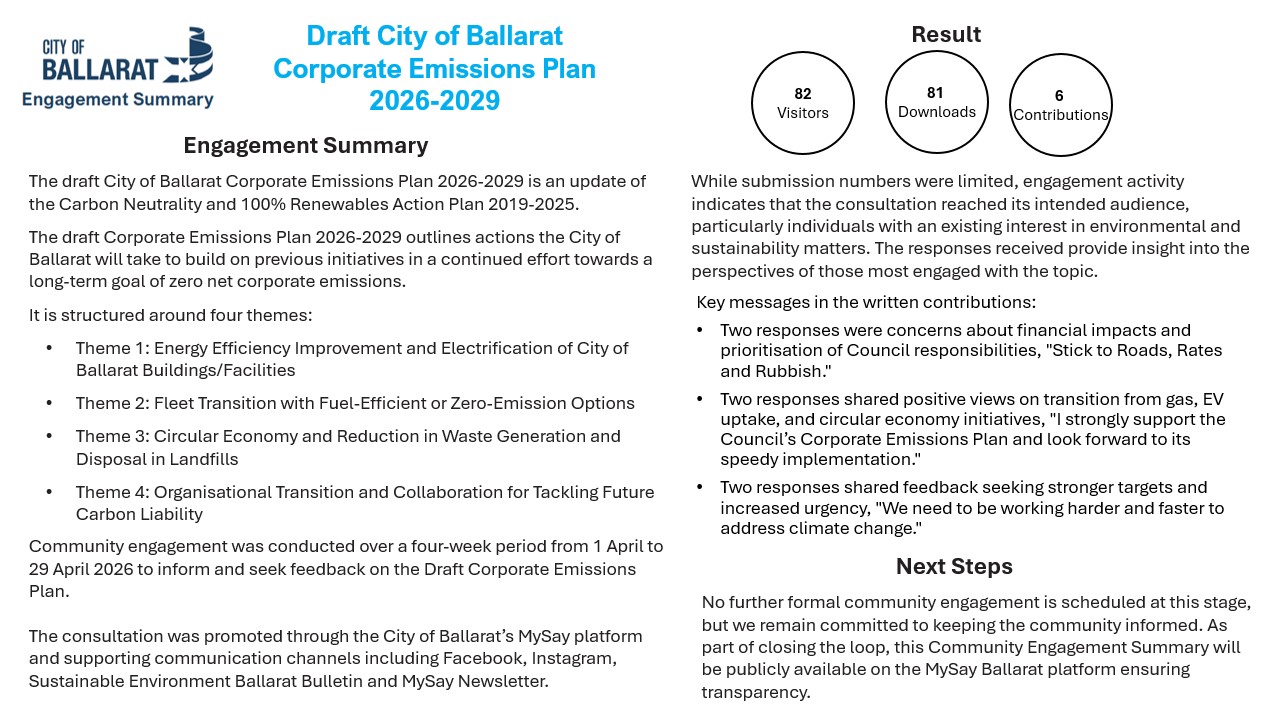
While the title of the document has been shortened, the draft Corporate Emissions Plan 2026-2029 outlines actions the City of Ballarat will take to build on previous initiatives in a continued effort towards a long-term goal of zero net corporate emissions.
It is structured around four themes:
City of Ballarat is currently responsible for the management and maintenance of more than 200 buildings and facilities with a value of approximately $490 million. These buildings and facilities range in size, age and use, and include the Town Hall, office buildings, operations depot, transfer station, recreational and sport facilities, libraries, family and children services, community centres, aquatic centres and the animal shelter.
These buildings and facilities use electricity and gas in their operations, which lead to carbon emissions. Several ongoing and planned initiatives including the Victorian Energy Collaboration (VECO) power purchase agreement and electrification of Ballarat Aquatic and Lifestyle Centre will significantly reduce the emissions.
The reduction in emissions in City of Ballarat owned buildings and facilities could be further enhanced through improved efficiency in and decarbonisation of energy use through electrification options and/or renewable energy sources.
City of Ballarat’s fleet vehicles and equipment are used to carry out operations and deliver community services. These activities directly emit greenhouse gases as fossil fuels to power the light and heavy vehicles as well as plant and equipment. City of Ballarat has already begun the transition to zero emission electric passenger pool fleets, and will continue to replace fuel vehicles with electric vehicles where fit for purpose and commercially viable.
Ballarat Regional Landfill receives waste from the communities it serves. It is under the City of Ballarat’s operational control and therefore its emission is included in our corporate emissions profile. The landfill gas capture and other landfill management measures at Ballarat Regional Landfill and closed landfills have been reducing, and will continue to reduce, methane emissions.
These efforts will be further enhanced through the ‘Waste as a Resource – Our Circular Economy’ Strategy. The Strategy provides a practical framework for the City of Ballarat and the community working together to reduce waste and support transition to a circular economy.
City of Ballarat will undertake all feasible emissions reduction actions to minimise the need for carbon offsetting activities to cancel out our remaining emissions. These include the residual direct emissions that could not be fully avoided from our activities as well as other indirect emissions that occur in the City of Ballarat’s value chain but within our sphere of influence.
Efforts are needed to reduce potential exposure to future carbon liability and high risk of increasing offset costs. These efforts, either individually or collaboratively, comprise strengthening sustainable procurement, implementing carbon drawdown and exploring carbon offset approaches.
Engagement Summary