Permits included in the Community Local Law are:
- Residential parking permit
- Street party permit
- Permit to ride motor bikes on Council land
- Permit to ride motor bikes on private land
- Permit to store long or heavy vehicles or shipping containers on roads or in ‘built up’ areas
- Permit to graze livestock on public roads or Council land
- Permit to camp outside prescribed camping areas
- Permit to place rubbish skips on roads or Council land
- Permit to burn off in ‘built up’ areas
- Permits to keep more than the allowed number of animals or any exotic animals.
Event and activity related permits include:
- Permit to use Council land or spaces for private events
- Permit to use fireworks anywhere in the municipality
- Permit for activities and events
- Busking permit.
Permits for businesses
The Community Local Law review will look at streamlining permit processes for:
- Display goods for sale
- Itinerant trading
- Spruiking, busking and pavement art
- Erecting or placing of advertising signs
- Sale and consumption of liquor on roads adjoining licensed premises
- Waste receptacle placed on roads or Council land
- Use of Council land or road for outdoor eating facilities.
See Clause 9 of the current Community Law 2017 for relevant Definitions
12.1. A person must not, without a Permit or other authority given by the Council, occupy or allow to be occupied any Council Land or any Road for any use including excavation, landscaping, cultivation, planting, building, erection of structures, installation of recreation facilities, Fencing, storage of Vehicles or goods of any kind, or any other use interference or change normally associated with the lawful occupation of land.
12.2. A person who commits an offence under Sub-clause 12.1 must remove and rectify any change he or she has made to Council Land or any Road as a result of the unauthorised occupation within 14 days of being directed to do so by an Authorised Officer or Delegated Officer or other reasonable time determined by the Council.
12.3. If a person (the offender) fails to remove and rectify any change he or she has made to Council Land or any Road under Sub-clause 12.2 the Council may remove and rectify the change and recover the cost of the removal and rectification from the offender.
12.4. Mowing a nature strip is excluded from Sub-clause 12.1.
Guidelines
Guidelines for determining whether to grant a Permit to allow a Person to occupy any part of Council Land or a Road for a specified purpose:
(1) Consider Council’s Nature Strip Policy.
(2) Consider whether this is the correct permit applicable or whether an alternative permit issued by Council is required, such as an event permit, use of reserve permit, roadside trading permit, outdoor dining facilities permit, asset protection permit, etc.
(3) Give priority to the safety of pedestrians, road users, and or lawful reserve users.
(4) Consider the community value of the proposed occupation activity.
(5) Consider referrals to other relevant Council Departments, such as Engineering Services, Events, Recreation and Open Space, Environment, Community Development and Planning.
(6) Impose essential conditions to mitigate or remove assessed risks.
(7) Ensure any permit issued is strictly limited to a specified place and a specified use.
(8) Ensure any permit includes the terms that:
(a) Council retains right of access to and inspection of the specified land at any time by an authorised officer or delegated officer.
(b) Council may cancel or suspend the permit for safety or any other reason, whether or not a condition of the permit has been breached.
(9) Consider appropriate time limits on permits.
(10) Ensure a current public liability insurance certificate is provided by the applicant prior to the issue of any permit, unless special exemption is given by Council’s Risk Department, a Council approved Policy, or another authorised Senior Officer of Council.
(11) Any other matter the Authorised Officer or the Delegated Officer reasonably believes is relevant to the application.
15.1. A Person must not burn, or cause, or allow to be burnt, in the open in any part of the Municipal District:
15.1.1. any Offensive materials; or
15.1.2. any materials that may cause Offensive emissions of smoke and odour to enter any neighbouring property.
15.2. A Person must not, without a Permit, burn outside, or cause, or allow to be burnt outside on any land in the Municipal District, any materials, whether in the open air or in any built or manufactured Incinerator or similar device. No permit is required for burning outside fire restriction periods for properties within the farming zone and properties within the rural living zone that exceed 2 hectares in area.
Guideline
a permit to burn should not be issued in Built Up Areas in the absence of the applicant establishing a compelling reason as to why the material proposed to be burnt cannot or ought not to be disposed of via Council’s waste collection. Note – Pursuant to Clause 7.3, any burning during a declared Fire Danger Period must adhere to the Country Fire Authority Act 1958 requirements.
15.3. A Person who has lit or allowed a fire to be lit or remain alight, or has burned or caused or permitted to be burned any materials, contrary to this Clause, must extinguish the fire or burning materials immediately on being directed to do so by an Authorised Officer or Delegated Officer.
15.4. The following exemptions apply in respect of this Clause:
15.4.1. With respect to Sub-clause 15.2:
15.4.1.1. a permanent or portable Barbeque for the purpose of cooking food or properly constructed or manufactured fireplace for the purpose of outdoor heating that is fit for purpose and designed constructed, located and installed in a manner that will prevent detrimental offsite amenity impact; or
15.4.1.2. for the purpose of meal preparation or personal comfort outside of a Built Up Area if:
15.4.1.2.1. the air movement in the vicinity of the fire is no stronger than 10km per hour;
15.4.1.2.2. the fire is lit in a properly constructed fireplace or in a trench at least 30cm deep;
15.4.1.2.3. the ground and airspace within a distance of 3m from the outer perimeters and uppermost point of the fire are clear of flammable material;
15.4.1.2.4. the fire does not occupy an area in excess of 1m² and the size of the fire and the dimensions of solid fuel used are the minimum necessary for the purpose; and 15.4.1.2.5. the fire is monitored by the Person(s) benefitting from the fire until it is completely extinguished.
15.4.2. Council staff members and any Person contracted or authorised by the Council for the purpose may, without a Permit, undertake controlled burning-off as a part of normal reserve maintenance on any Council Land or Road;
15.4.3. Fire Agencies carrying out training or fire hazard reduction activities; and
15.4.4. An Authorised Officer or Delegated Officer may grant exemptions to any part of this Clause in special or unusual circumstances, such as in emergencies, urgent circumstances or natural disasters. Note that permits cannot be issued under sub-clause 15.2 during a Fire Danger Period declared under the Country Fire Authority Act 1958. Fire Danger Period and Total Fire Bans must be complied with. Some situations may not require a Local Laws permit.
A Person must not, without a Permit, light or cause or allow to be lit any fireworks on any land.
A Person, must not, without a Permit, camp on any land other than Council Land unless:
18.1.1. the Person is within a registered caravan park, Camping Area or other area determined to be available for camping purposes by the Council; or
18.1.2. the Person is the owner or occupier of the land or has the permission of the owner or occupier, and:
18.1.2.1. camps for a maximum period of 60 days in any six (6) month period, provided that sanitation and laundry facilities of a Dwelling located on the land are available to all persons camping; or
18.1.2.2. camps for a maximum period of 30 days in a 12 month period, in the case of vacant land outside a Built Up Area.
Guidelines
for determining whether to grant a Permit to allow a Person to camp
(1) In determining whether to grant a permit to allow camping in an area which is on any land other than Council land, is not a registered caravan park and has not been declared by the Council to be a ‘camping area’, the Council or an authorised officer or a delegated officer must, where relevant, have regard to the following guidelines:
(a) the location of the land;
(b) the land-use of the applicant’s land and that of adjoining allotments;
(c) the suitability of the land for camping including extent of screening from neighbours;
(d) the number of tents or other structures to be located on the land;
(e) the length of time the tents and other structures will be erected on the land;
(f) on properties of less than 0.5 hectares, only one caravan or campervan may be placed on the land for camping purposes;
(g) the availability of sanitation and laundry facilities to the land or in a Dwelling on or adjoining the land;
(h) any likely damage to be caused; and
(i) any other matter the authorised officer or delegated officer reasonably believes is relevant to the application.
(2) In determining whether to re-issue, extend, vary or cancel a permit to camp or occupy a campsite on any land other than Council land the Council or an authorised officer or a delegated officer must, where relevant, have regard to where camping is on vacant land unsupervised by the occupier whether the applicant campers are compliant with the following campsite guidelines:
(a) at all times maintaining the campsite in a clean and tidy condition including but not limited to no unconstrained rubbish which is likely to become litter;
(b) prior to vacating the campsite, removing all litter (including remnant human excreta and toilet paper) and other refuse from the campsite to a Council authorised disposal point;
(c) providing approved toilet facilities;
(d) any other matter the authorised officer or the delegated officer reasonably believes is relevant to the application.
A Person must not, without a permit or unless under the provisions of the Ballarat Planning Scheme:
19.1. cause or allow a shipping container to be placed on any Council Land or Road or
19.2. allow any shipping container to adversely impact the visual amenity of a neighbourhood.
19.3. Sub-clause 19.1 does not apply to the Council or any person employed, contracted or authorised by the Council for the purpose.
Guidelines
for determining whether to grant a permit for a shipping container on any land other than Council land or a road:
(1) The permit for a shipping container will be for a number of days or up to the date on the permit.
(2) If the authorised officer or the delegated officer reasonably believes the shipping container on the land other than Council land or a road will create a traffic hazard, obstruction or other danger to the public, the applicant may be required to take out a public liability policy of insurance (minimum $10 million) in which case, prior to the issue of the permit or the placement of the container, the Council must be provided with a Certificate of Currency of the public liability policy of insurance for the application.
(3) The shipping container must not be placed on any Council land or on a road, kerb, footpath or nature strip unless specifically permitted at a nominated location.
(4) Any concerns that the authorised officer or the delegated officer may have about safety must be satisfactorily resolved prior to the issuing of a permit. It is the permit holder’s responsibility to ensure the container does not represent an unacceptable risk to the health and safety of the public or any other person, which includes but is not limited to securing the container either open or shut when unattended to prevent accidental imprisonment and/or suffocation.
(5) The applicant must not intend to use or actually use the container as a permanent structure. If the applicant indicates an intention to use the container as a permanent shed, the applicant should be informed that an application for a Building Permit is required and a Planning Permit may be required.
(6) Any damage to any Council property caused by the placement or removal of the shipping container, including the pavement, nature strip and services is to be reinstated by the permit holder.
(7) If the shipping container on land other than Council land or a road nevertheless constitutes a traffic hazard or obstruction, the container must be appropriately treated (reflective tape and/or lights) to be sufficiently visible to prevent the hazard to the public.
(8) Any other matter the authorised officer or the delegated officer reasonably believes is relevant to the application.
Note: A building permit is required for the use of a shipping container for any use that departs from the definition of a shipping container herein, such as for use as a building for storage or a dwelling. In these circumstances, a Building permit must be obtained prior to siting and, a certificate of occupancy and final inspection prior to use.
22.1. An owner or occupier of any land must not, without a Permit:
22.1.1. keep or allow to be kept more than 6 different types of any Animal on any one parcel of land of 2 hectares or less at any time; and
22.1.2. must not keep or allow to be kept any more in number, for each type of Animal, than is set out in the Table of Animal Types and Numbers in this Clause.
22.2. For the purposes of the table in clause 22.1:
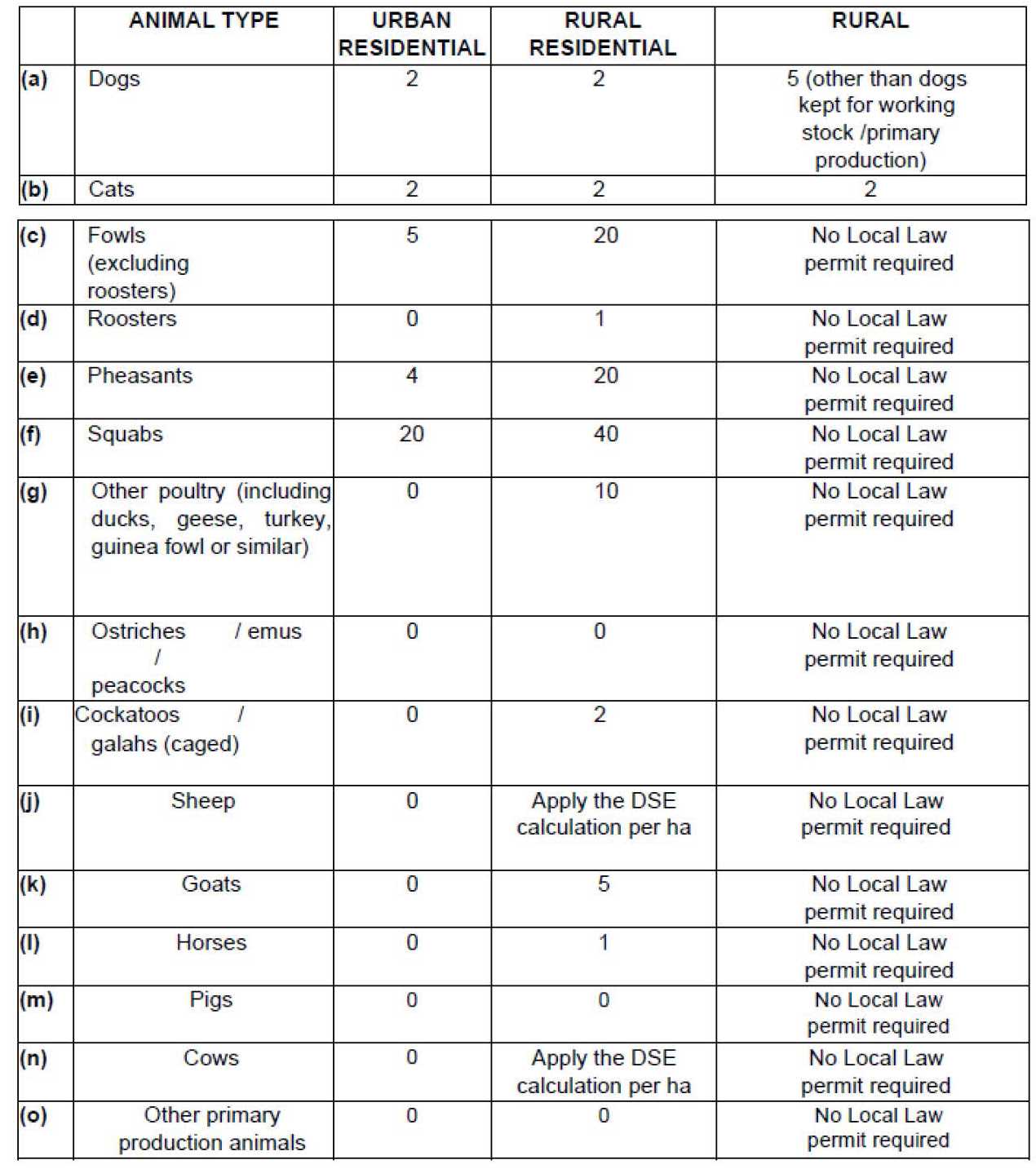
22.2.1. ‘Urban Residential’ means land within the General Residential Zone, Commercial 1 Zone, Commercial 2 Zone, Neighbourhood Residential Zone, Residential Growth Zone, Mixed Use Zone or Township Zone;
22.2.2. ‘Rural Residential’ means land within the Low Density Residential Zone or Rural Living Zone; and
22.2.3. ‘Rural’ means land within the Farming Zone, Rural Conservation Zone, Industrial 1 Zone; Industrial 2 Zone or Industrial 3 Zone.
22.3. Unless contrary to other State or Commonwealth legislation, a Permit is also required to keep or allow to be kept any exotic, wild, dangerous, or large Animal not listed in Sub clause 22.1.
22.4. For the purpose of calculating the numbers of any Animal kept under Sub-clause 22.1, the progeny of any Animal lawfully kept will be counted from 12 weeks after its birth.
22.5. Where at the date immediately prior to the day of the commencement of this Local Law any owner or occupier of land lawfully keeps a number of Animals in excess of the new maximum number or type of Animals given in the Table of Animal Types and Numbers in Sub-clause 22.1, and those Animals, where required, are registered with the Council:
22.5.1. that maximum number will be increased for that owner or occupier to include those previously lawful Animals, but only until that time when those individual Animals in excess of the new maximum die or are otherwise disposed of; and
22.5.2. for roosters the time period referred to in Sub-clause 22.5.1 cannot exceed two years from the commencement date of this Local Law; and
22.5.3. those excess Animals may not be replaced, unless by Permit.
22.6. Any person keeping Honey Bees must comply with the Victorian Apiary Code of Practice (2011) as prepared and amended from time to time by the Department of Economic Development, Jobs, Transport and Resources.
22.7. Any owner or occupier of the land must destroy any English or European wasps nesting on the land.
30.1. The Council may from time to time designate any area as an area in which a Residential Parking Policy is in operation.
30.2. The Council may at any time rescind, amend or vary any Residential Parking Policy so designated.
30.3. A person who resides in an area in which a Residential Parking Policy is in operation may make application to the Council for a Residential Parking Permit.
30.4. A Residential Parking Permit must be displayed in accordance with Council’s Residential Parking Policy.
30.5. A Residential Parking Permit may specify the road or roads or part of the road to which the permit applies.
30.6. The holder of a Residential Parking Permit may park an eligible vehicle in the road or roads as specified in the permit without being required to comply with any parking restrictions as to time indicated by parking signs associated with the road or roads.
30.7. The Council may from time to time by resolution determine a fee to be paid for a Residential Parking Permit.
30.8. Prior to the introduction of a new Residential Parking Policy the Council must notify the owner and occupier of every residence in the area advising as to:-
30.8.1. eligibility;
30.8.2. how to apply for a permit;
30.8.3. the cost of the permit;
30.8.4. and how the policy operates.
31.1. A Person must not on any part of any Council Land excluding a Road, without a Permit:
31.1.1. drive, ride on or otherwise use; or
31.1.2. permit a person under his or her care or control to drive ride on or otherwise use a Motor Bike or other Motorised Recreational Vehicle, unless the part of the Council Land has been designated for that purpose.
31.2. A Person must not, without a Permit:
31.2.1. drive, ride on or otherwise use any Motor Bike or other Motorised Recreational Vehicle in a Built Up Area on any land other than Council Land or a Road, except for the purpose of directly accessing or leaving that land;
31.2.2. drive, ride on or otherwise use any Motor Bike or other Motorised Recreational Vehicle outside a Built Up Area on any land other than Council Land or a Road, within 500 metres of a Dwelling located on any other land;
31.2.3. as the owner or occupier of any land outside a Built Up Area, allow a Person to drive, ride on or otherwise use any Motor Bike or other Motorised Recreational Vehicle on that land within 500 metres of a Dwelling located on any other land;
31.3. A Person is exempt from Sub-clause 31.2.2 and 31.2.3 provided that Person has obtained a written consent:
31.3.1. from all adjoining property occupiers; and
31.3.2. from all other occupiers of Dwellings within 500 metres of the subject land; and that written consent:
31.3.3. includes the period of consent, time of day, number of hours, days of the week and maximum number of Vehicles at any one time to be included in the consent;
31.3.4. clearly states that the consent expires if the occupier changes during the period of the consent or if the occupier notifies the Person in writing of their withdrawal of consent;
31.3.5. is copied to the consenting occupier after signing;
31.3.6. is the limit and extent of any exemption from Sub-clauses 31.2.2 and 31.2.3; and
31.3.7. if varying in any detail between consenting occupiers, the most restrictive consent becomes the limit and extent of any exemption from Sub clauses 31.2.2 and 31.2.3.
Note: Pursuant to Clause 9 Definitions: ‘Motor Bikes and Motorised Recreational Vehicles’ - a motorised farm vehicle that is being used for farming purposes is exempt.
A Person must not, without a Permit, keep or store or repair or allow to be kept, stored or repaired any Heavy Vehicle or Long Vehicle:
34.1. upon any Road or part of a Road for which the Council is the Responsible Road Authority for the purposes of the Road Management Act 2004;
34.2. on any other land less than 0.5 hectares in a Built Up Area; or
34.3. on any other land less than 5 hectares for three or more Heavy Vehicles or Long Vehicles.
Guidelines:
(1) the land-use of the applicant’s land and that of adjoining allotments;
(2) whether planning permission is required for a business or other use;
(3) the maximum number of vehicles at any one time to be kept or stored;
(4) the likely effect on adjoining owners, including visual amenity, fumes and noise;
(5) mitigation measures the applicant is willing to undertake as a condition of the permit; and
(6) any other matter the authorised officer or the delegated officer reasonably believes is relevant to the application.
A Person must not, unless in accordance with this Local Law or with a Permit, place or cause to be placed on any Road or Council Land:
35.1. any mobile Waste bin, Council approved Waste bin, Trade Waste hopper, builder’s Refuse Container, skip bin, Bulk Waste Container or other Waste container; or
35.2. any Waste materials of any nature, including Domestic Waste, Green Waste and Recyclables.
Guidelines
(1) whether the placement will obstruct the passage of vehicles and pedestrians, or otherwise create a hazard;
(2) whether the placement will contravene any traffic control signs;
(3) protection of any Council assets;
(4) whether a copy of a valid policy of insurance Certificate of Currency has been provided to the Council;
(5) whether an indemnity or guarantee has been provided to the Council; and
(6) any other matter the authorised officer or the delegated officer reasonably believes is relevant to the application.
38.1. A Person may not, without a Permit:
38.1.1. hold a Street Party, Street Festival or Procession, Event or activity on a Road; or
38.1.2. use an audible public address system on a Road or Council Land.
38.2. Political or industrial marches are exempt under this Clause, provided Victoria Police are informed prior to the march.
Guideline
In determining whether or not to grant a permit for a Street Party, Street Festival or Procession, Event or activity on a Road, the Council may take into account:-
(1) whether the Street Party, Street Festival or Procession, Event or activity on a Road will unreasonably inconvenience road users or owners and occupiers of land with vehicular access to the section of road to be closed;
(2) whether the written permission of the Victoria Police and the Roads Corporation has been obtained and their requirements met;
(3) whether the road can be closed to vehicular traffic, or partly closed with safe and effective separation of vehicular traffic and festival or procession patrons and equipment; and
(4) any other matter relevant to the circumstances of the application.
Where an application is to conduct a Street Festival or Procession, Event or activity on a Road, the application must be made at least 28 days before the event is to take place.
In determining whether to grant a permit for a Street Party, the Council must take into account:-
(1) whether the road can be closed to vehicular traffic for the duration of the Street Party without detriment to the traffic management of the area;
(2) whether all owners or occupiers of land with any vehicular access via the section of road to be closed have been advised by letter and given seven days to comment or object;
(3) whether a person on behalf of the applicant has been nominated to erect and remove the barriers which close the road at locations and times specified by an Authorised Officer;
(4) whether the footpath on at least one side of the road can be kept clear of obstructions; and
(5) any other matter relevant to the circumstances of the application.
(6) Where an application is to conduct a Street Party the application must be made at least 14 days before the Street Party is to take place.
39.1. A Person must not, without a Permit, undertake the Grazing of Livestock or the Droving of Livestock on a public Road or Council Land.
40.1. A Person must not, without a Permit, place or display any goods for sale or samples of goods for sale or cause or allow another Person under his or her control to do so on any part of a Road or Council Land.
40.2. A Person who has placed, permitted to be placed, displayed or permitted to be displayed goods or an Advertising Sign on a Road or Council Land, with or without a Permit, must move or remove them if directed to do so by an Authorised Officer or Delegated Officer.
40.3. Any goods left or displayed on any part of a Road or Council Land contrary to this Clause or displayed in contravention of any conditions of a Permit may be removed by an Authorised Officer or a Delegated Officer and impounded.
40.4. Where any goods have been impounded, there must be compliance with the provisions of Clause 84.
41.1. A Person must not, without a Permit, erect or place on any Road or Council Land any Vehicle, caravan, trailer, table, stall, tent, or other structure for the purposes of Selling or offering for sale any goods (including any Vehicle) or services.
41.2. In addition to any other power which it has, the Council may, by resolution, determine a fee, charge, fare or rent in relation to the Selling or offering for sale any goods or services from any land adjacent to a Road or to any Person who is on that Road or adjacent land.
41.3. Where any goods and equipment have been impounded, there must be compliance with the provisions of Clause 84.
Guideline
for determining whether to grant a permit to allow trading from a road or to a person on a road or to allow trading on Council land:
(1) whether the safety of road users or the passage of any vehicle will be affected by the placement or performance;
(2) will the activity be detrimental to the amenity of the area including adjacent property occupiers or lawful users of the adjoining public space;
(3) the nature and duration of the proposed trading and whether any time limitations should be imposed, for reasons associated with public safety; asset protection, adequate lighting, traffic management etc.;
(4) whether appropriate arrangements can be made for:- a. waste water disposal; b. recycling, litter and garbage; c. lighting; and d. advertising signs;
(5) Comments from Council Departments including: a. Roads management or relevant land asset (reserve) manager, b. Planning Department c. Economic development
(6) whether the consent of VicRoads has been obtained where the road is an arterial road or a VicRoads controlled road;
(7) whether any indemnity/guarantee has been provided to the Council;
(8) whether required permits been obtained under the Food Act 1984, the Public Health and Wellbeing Act 2008 or any other legislation;
(9) whether the applicant should be required to take out a public liability policy of insurance (minimum $20 million) and prior to the issue of the permit, provide to the Council a Certificate of Currency of the public liability policy of insurance.
(10) the following business competition issues should be considered, especially where local retail businesses object to the roadside trading:
a. is there an overriding value to the broader community and to tourism in the provision of an essentially different and convenient service;
b. will the offering of a broader service mix in the locality improve local amenity by encouraging new customers and placing competitive pressure to improve retail service standards in the area;
c. has there been an open and competitive process to obtain roadside trading location permits or should such a process by undertaken;
d. Council policy concerning roadside trading sites;
e. is the location likely to place the roadside trader in direct competition with any other exclusively contracted Council business, such a Recreation Centre café operator;
f. should the roadside trader’s range of goods and services be specified and limited by Council; g. should the hours of proposed trading be limited for competition purposes.
(11) Council’s policy in relation to itinerant or roadside trading.
(12) any other matter the authorised officer or the delegated officer reasonably believes is relevant to the application.
42.1. A person must not, without a Permit, Spruik on any Road or Municipal Place or from any private property use any sound amplification equipment to Spruik onto any Road or Municipal Place.
42.2. A person must not, without a Permit, Busk on any Road or Municipal Place or use any sound amplification equipment for the purpose of public entertainment or performance.
42.3. A person must not, without a Permit, paint or draw on any Road or Council Land or property for the purpose of public entertainment, performance or the collection of money.
42.4. Sub-clauses 42.1, 42.2 and 42.3 do not include short-term outdoor community Events on Council Land or a Road although such Events may be subject to a Permit under other clauses of this Local Law.
43.1. A Person must not, except in accordance with a Permit, erect or place an Advertising Sign on or over any part of a Road or Council Land, or cause or in any way authorise another Person to do so.
43.2. A Person who has erected or placed an Advertising Sign on a Road or Council Land with or without a Permit, must move or remove the Advertising Sign if directed to do so by an Authorised Officer or Delegated Officer.
43.3. Where an Advertising Sign has been impounded, there must be compliance with the provisions of Clause 84.
43.4. Any signage subject to a Permit for use within a Municipal Reserve or subject of a Planning Scheme permit is exempt from this Clause.
44.1. A Person must not, without a Permit, use a Footpath or any part of a Road or any Council Land for the purposes of an Outdoor Eating Facility.
44.2. Where any tables, chairs, umbrellas or other equipment have been impounded, there must be compliance with the provisions of Clause 84.
44.3. A Permit Holder must move or remove the Outdoor Eating Facility to which the Permit relates when requested to do so for the purposes of public safety by an Authorised Officer or a Delegated Officer or a member of the Victoria Police or an emergency service.
For guidance in determining whether to grant a permit to use a Footpath or any part of a Road or Council land for the purpose of an Outdoor Eating Facility, refer to Council’s policy in relation to Outdoor Dining and Trading Policy 2017.
45.1. A Person must not, without a Permit, use a Footpath, other part of a Road, or any Council Land adjoining a Licensed Premises to sell or consume liquor.
45.2. In determining whether to grant a Permit, the Council or an Authorised Officer must have regard to the Guidelines set out in this Local Law.
Guidelines:
(1) the location of the licensed premises, the land use of adjoining allotments and the general amenity of the street and neighbourhood;
(2) the nature of the existing licensed business, eg café, restaurant or night-time entertainment venue;
(3) whether the applicant’s business, or the location has a history of alcohol-related behavioural problems;
(4) comments from Planning, Community Development, Environmental Health, and Economic Development departments of Council;
(5) comments from the Victoria Police or any relevant other public authority;
(6) the impact that an increased number of patrons and the service and consumption of alcohol on a footpath will have on the amenity of the surrounding areas;
(7) whether Council’s permit hours should be the same or be more limited than the existing liquor license for the site;
(8) whether Council’s permit should be conditional upon patrons being seated while consuming alcohol and/or food service being available in the area that is the subject of the application; and
(9) any other matter the Authorised Officer or the Delegated Officer reasonably believes is relevant to the application.
46.1. For the protection of assets vested in Council, the:
46.1.1. owner of any land;
46.1.2. builder engaged to carry out Building Work on land;
46.1.3. appointed agent; or
46.1.4. demolition contractor in the case of Building Work involving demolition, must, where deemed necessary in accordance with Council’s Asset Protection Policy:
46.1.4.1. obtain an Asset Protection Permit before carrying out any Building Work, or allowing the Building Work to be carried out on that land;
46.1.4.2. not carry out or allow to be carried out any Building Work on that land unless an Asset Protection Permit has been obtained; and
46.1.4.3. comply with the conditions of any Asset Protection Permit issued by the Council.
46.2. An Asset Protection Permit in respect of any land where Building Work is to be carried out may be issued by an Authorised Officer or Delegated Officer on completion of an application form and payment of the application fee.
46.3. An Asset Protection Permit may allow a Person to enter land from a road other than by a permanently constructed vehicle crossing;
46.4. An Asset Protection Permit may be subject to such conditions for the protection of Council’s assets and the safety of the persons or property as the issuing authorised officer determines including but not limited to:
46.4.1. requiring protection works to be done;
46.4.2. requiring the payment of a security bond;
46.4.3. requiring that any or all public assets or infrastructure damage be cleaned, repaired, replaced or re-instated within a specified time and to the satisfaction of the Council;
46.4.4. requiring the Asset Protection Permit holder to notify Council in writing immediately on becoming aware of any damage to any Council asset as a result of the building work or work associated with the building work including the delivery or removal of materials or equipment;
46.4.5. requiring a temporary Vehicle Crossing to be installed to the Council's specification before commencement of any Building Work or delivery of any equipment or materials to the land; and
46.4.6. any other condition considered necessary.
46.5. The amount of any security bond required under any Asset Protection Permit must be proportionate to the likely costs of repairing any potential damage to any existing Council Land, Road (including carriageway), channel, drain, Vehicle Crossing or other public asset arising from the works the subject of the Permit.
46.6. When the Council receives notice of the completion of the works the subject of the Permit, the land will be inspected by the Council and the amount of the security bond:
46.6.1. may be retained by the Council to the proportion necessary to offset the costs of carrying out any works to rectify any damage, provided the person who lodged the bond is first notified of the damage and declines or fails within 30 days to make good the damage at their own expense to the Council’s satisfaction; or
46.6.2. must be refunded to the person who lodged it upon the Council's satisfaction that no damage has been caused, or that any damage caused has been repaired by, or on behalf of, that person to the Council's satisfaction, or when, after 30 days of receiving notice of completion of the works, the Council has not notified the Person who lodged the bond of any damage requiring repair.
46.7. The person who lodged the bond must supplement the bond by a further payment equal to the difference between the cost of carrying out any works and the amount of the bond, if the Council is satisfied that the amount of the bond is insufficient to meet such cost and it makes a demand for such payment in writing.
46.8. Where the Council so determines, it may at its absolute discretion, agree to accept an alternative form of security to a security bond.
46.9. A person who is not one of the persons described in Sub-clause 46.1 must not:
46.9.1. carry out Building Work on land unless, in respect of the Building Work, an Asset Protection Permit has been obtained; or
46.9.2. deliver to a Building Site any equipment or materials unless an Asset Protection Permit has, in respect of the Building Work being carried out on the land, been obtained.
Where any Building Work is being carried out on any land, the:
47.1.1. owner of any land;
47.1.2. builder engaged to carry out Building Work on land;
47.1.3. appointed agent; or
47.1.4. demolition contractor in the case of Building Work involving demolition, must ensure that the Building Site is developed and managed to prevent stormwater pollution, through the contamination of run-off by chemicals, sediment, animal wastes or gross pollutants by adopting measures to:-
47.1.5. Minimise the amount of mud, dirt, sand, soil or stones deposited in the abutting roads or washed into the stormwater system; and
47.1.6. Prevent building clean up, wash down or other wastes being discharged offsite or allowed to enter the stormwater system.
47.2. A person must not deposit, or allow to be deposited, into any drain vested in the Council any Waste material other than stormwater.
48.1. For occupying a Road or Council Land and for the protection of the public, a Hoarding permit is required for the protection of assets vested in Council.
48.2. The:
48.2.1. owner of any land;
48.2.2. builder engaged to carry out Building Work on land;
48.2.3. appointed agent; or
48.2.4. demolition contractor in the case of Building Work involving demolition, must:
48.2.4.1. obtain a Hoarding Permit before:
48.2.4.1.1. occupying or fencing off part of a Road or Council Land, for any Building Work, or allowing the Building Work to be carried out;
48.2.4.1.2. blocking any Road with a Vehicle or any other machinery or temporary structure;
48.2.4.1.3. erecting a hoarding, scaffolding or overhead protective awning on or over Road or Council land;
48.2.4.1.4. using a mobile crane or travel tower to carry out Building Work on or over a Road or Council Land;
48.2.4.2. not carry out or allow to be carried out any Building Work on a Road or Council land. Unless a Hoarding Permit has been obtained; and
48.2.4.3. comply with the conditions of a Hoarding Permit issued by the Council.
48.3. A Hoarding Permit where Building Work is to be carried out on a Road or Council Land may be issued by an Authorised Officer or Delegated Officer on completion of an application form and payment of the application fee.
48.4. A Hoarding Permit may be subject to such conditions for the protection of Council’s assets and the safety of the public, persons or property as the issuing authorised officer determines including but not limited to:
48.4.1. requiring a traffic management plan;
48.4.2. requiring protection works to be done;
48.4.3. requiring the payment of a security bond;
48.4.4. requiring that any or all public assets or infrastructure damage be cleaned, repaired, replaced or re-instated within a specified time and to the satisfaction of the Council;
48.4.5. requiring the Hoarding Permit holder to notify Council in writing immediately on becoming aware of any damage to any Council asset as a result of the building work or work associated with the building work including the delivery or removal of materials or equipment; and
48.4.6. any other condition considered necessary.
48.5. The amount of any security bond required under any Hoarding Permit must be proportionate to the likely costs of repairing any potential damage to any existing Council Land, Road (including carriageway), channel, drain, Vehicle Crossing or other public asset arising from the works the subject of the Permit.
48.6. When the Council receives notice of the completion of the works the subject of the Permit, the land will be inspected by the Council. Any damage identified by the Council will be rectified by the Hoarding Permit holder or at a cost to the Hoarding Permit holder using the following means:
48.6.1. Notice to Comply issued to Hoarding Permit holder to reinstate damaged assets;
48.6.2. Council engage the works to be completed and recover the costs at the expense of the Hoarding Permit holder;
48.6.3. The amount of the security bond may be retained by the Council to the proportion necessary to offset the costs of carrying out any works to rectify any damage, provided the person who lodged the bond is first notified of the damage and declines or fails within 30 days to make good the damage at their own expense to the Council’s satisfaction; or
48.6.4. The amount of the security bond must be refunded to the person who lodged it upon the Council's satisfaction that no damage has been caused, or that any damage caused has been repaired by, or on behalf of, that person to the Council's satisfaction, or when, after 30 days of receiving notice of completion of the works, the Council has not notified the Person who lodged the bond of any damage requiring repair.
48.7. The person who lodged the bond must supplement the bond by a further payment equal to the difference between the cost of carrying out any works and the amount of the bond, if the Council is satisfied that the amount of the bond is insufficient to meet such cost and it makes a demand for such payment in writing.
48.8. Where the Council so determines, it may at its absolute discretion, agree to accept an alternative form of security to a security bond.
48.9. A person who is not one of the persons described in Sub-clause 46.1 must not:
48.9.1. carry out Building Work on a Road or Council land unless, in respect of the Building Work, a Hoarding Permit has been obtained;
48.10. An exemption applies to a Person acting contrary to this Clause where the Person is exempt under the Road Management Act 2004
48.11. An Authorised Officer or Delegated Officer may, in connection with a proposal to occupy a Road or Council land, require a traffic management plan and or a Waste management plan be provided to the Council adequately addressing any parking or Traffic or Waste management issues.
(Note: A person must not conduct any works in, on, under or over a road without the written consent of the Council as per the Road Management Act 2004. A person must adhere to the Road Management Act 2004 – Schedule 7 unless exemptions apply under this legislation.)
53.1. A Person must not, without a Permit, construct, install, remove, relocate or alter a Vehicle Crossing, whether temporarily or permanently.
53.2. Each owner and occupier of land must not, without a Permit:
53.2.1. construct or allow to be constructed;
53.2.2. or use or allow to be used a second or subsequent Vehicle Crossing to service the land.
63.1. A Person must not, without a Permit:
63.1.1. leave or allow to be left any:
63.1.1.1. Bulk Waste Container on a Road or Council Land; or
63.1.1.2. other thing on a Road or Council Land which encroaches on, or obstructs the free use of, the Road or Council Land or which reduces the breadth, or confines the limits, of the Road or Council Land.
63.2. A Person who has left or allowed to be left a Bulk Waste Container or other thing on a Road or Council Land with or without a Permit or other authorisation, must move or remove them if directed to do so by an Authorised Officer or Delegated Officer.
63.3. If a Person reasonably suspected of having committed an offence under Sub-clause 63.1 is the driver of a Vehicle which transports a Bulk Waste Container or other thing and that person cannot be found or it is impracticable to charge that person with an offence under Sub-clause 63.1, any Person who is an owner, manager or director of the business which supplies the Bulk Waste Container or other thing which is left on and obstructs the free use of a Road or Council Land may be charged with and is capable of committing an offence under Sub-clause 63.1.
63.4. Anything left or allowed to be left contrary to Sub-clause 63.1, or in contravention of any conditions of a Permit or other authorisation, may be removed by an Authorised Officer or Delegated Officer and impounded.
A Person must not undertake any of the following activities on a Municipal Reserve without first obtaining a Permit:
66.1. organise any competitive sport, game, or activity other than a sport, game, or activity played for family or social purposes;
66.2. organise any Event, unless in possession of an Event Permit from the Council; (see Clause 68 Events);
66.3. conduct or celebrate a wedding;
66.4. consume or possess any Liquor in open containers other than between sunrise and sunset (see also Clause 56 Possession and Consumption of Liquor after Sunset in Municipal Places Other than Roads);
66.5. organise or hold any rally, procession, demonstration or any other public gathering, in which case such a Permit must not be unreasonably withheld;
66.6. make a collection of money;
66.7. use an amplifier or public address system (see also Clause 38.2 public address systems on Roads and Council Land );
66.8. operate or otherwise use any watercraft, unless in an area clearly designated for the purpose;
66.9. construct or install a film set, or record for television or other media purposes, any event or activity, if the construction, installation or recording (as the case may be) is for fee or reward or commercial purposes (but excluding wedding and general photography or recording and any media photography or recording for news production purposes);
66.10. pitch any tent, or erect any temporary structure or shelter, whether for Camping or other purposes, but excluding temporary shade structures used on a daily basis for casual purpose (see also Clause 69 Camping on Council Land or a Road);
66.11. drive any Livestock (see also Clause 39 Livestock on Roads);
66.12. use, possess, ignite or engage any person for the use, possession or ignition of fireworks (see also Clause 17 Fireworks);
66.13. ride or drive a Vehicle or Animal in a manner or in a place likely to damage or ruin any grassed area or turf surface or otherwise interfere with the use of the reserve (see also Clause 31.1 Motor Bikes and Motorised Recreational Vehicles - on Council Land);
66.14. ride any horse other than in an area and at a time designated by the Council;
66.15. drive, ride in or on, park upon or otherwise use any motor vehicle other than in an area designated by the Council (note also Clause 70 Parking on Municipal Reserves);
66.16. launch into any wetland, lake, pond or other watercourse on Council Land or a Road any watercraft other than from a launching facility designated for such purpose;
66.17. Sell or offer for sale any other goods or services including any intoxicating Liquor to any Person (see also Clause 40 Displaying Goods for Sale on Council Land or a Road and Clause 41 Itinerant Trading);
66.18. operate, or cause to be operated, any amusement for which a charge is made or to make a collection of money for any purpose;
66.19. operate tour guiding, personal training or any other organised recreational activity for commercial gain;
66.20. live on or Camp in a boat moored to a Council jetty, pontoon, boat ramp or pier;
66.21. conduct repairs to any boat or watercraft moored to a Council jetty, pontoon, boat ramp or pier except in an emergency breakdown for the purpose of removing it;
66.22. erect, fix or place any advertisement for educational, cultural, political, religious, social, or recreational purposes by any Person. Any sign erected:
66.22.1. must not be animated or internally illuminated;
66.22.2. must not exceed 5 square metres;
66.22.3. must not remain in place any longer than 14 days after the event, or remain in place any longer than 3 months (whichever time is shorter); and
66.22.4. must be placed in close proximity to the Event or other location nominated by an Authorised Officer or a Delegated Officer.
(Any Advertising Sign which does not conform to these signage requirements may be subject to a planning permit.)
66.24. An Authorised Officer or Delegated Officer when assessing whether a Permit is required, may decide that a specific activity, although included in this Clause, is of such small duration, size or other relevant factor that no Permit is required.
66.25. A Person employed, contracted or authorised by Council for a specific purpose in a Municipal Reserve is exempt from this Clause so far as it applies to that purpose.
68.1. A Person must not, without a Permit, hold or organise any Event on any Council Land or Road within the Municipal District.
68.2. A Person must not, without a Permit, hold or organise any Event on any land other than Council Land or a Road within the Municipal district if that Event may reasonably be expected to have a material impact on the neighbouring community or a materially increased risk to public safety or to Council assets.
68.3. The following exemptions apply in respect of this Clause:
68.3.1. an Authorised Officer or a Delegated Officer may assess an application and may decide that, based on the circumstances of the matter, a Permit under sub-clause 68.1 or 68.2 is not required (although certain activities may still require a Permit under Clauses 65-66 – Use of Municipal Reserves); and
68.3.2. an Event that is subject to a planning permit is exempt from the requirement of a Permit under Sub-clause 68.1 or 68.2.
A Person must not, without a Permit, Camp on any Council Land (including a Municipal Reserve) or a Road unless such Person is within a registered caravan park or a Camping Area.
(Camping on land other than Council Land or a Road may be permitted but may be subject to a separate Permit. See Clause 18: Camping on Land other than Council Land or a Road.)
70.1. The registered owner of a Vehicle must not, or must not allow, without a Permit, that Vehicle to be parked on any part of any Municipal Reserve other than in a parking area that is set aside for that purpose by the Council or agreed to by the Council or an Authorised Officer or a Delegated Officer.
70.2. Sub-clause 70.1 does not apply to any Council employee, contractor or authorised person acting in the course of his or her duties.
85.1. The Council, any Authorised Officer, or a Delegated Officer may define the form of any Permit application, the manner in which a Permit application will be processed and the terms and conditions under which a Permit may be issued.
85.2. In addition to any other conditions applied to any Permit under this Local Law, Standard Permit Conditions applicable to all Permits under this Local Law are available on Council’s website.
85.3. A Permit expires on the date specified in the Permit or if no such date is specified the Permit will expire one (1) year after the date of issue.
85.4. The Council or an Authorised Officer or Delegated Officer may correct a Permit after issuing it, if the Permit contains a clerical error, an error from accident, slip or omission, an evident material miscalculation, or material mistake in the description of any person, thing, date or property referred to in the Permit.
85.5. Where the Council or an Authorised Officer or Delegated Officer is of the opinion that there is or has been a breach of any conditions of a Permit, a Notice to Comply may be issued to the Permit Holder, or the Permit may be cancelled or new conditions may be applied.
85.6. The Council or an Authorised Officer or Delegated Officer may amend or cancel any
Permit if it is found:
85.6.1. to contain a material misstatement or concealment of facts in relation to the application for the Permit;
85.6.2. any material change of circumstances occurs after the issue of the Permit;
85.6.3. a failure to comply with the conditions under which the Permit was issued; or
85.6.4. a failure to comply with a Notice to Comply within the time specified in relation to a breach of a condition of the Permit.
85.7. The Council or an Authorised Officer or Delegated Officer must notify the Permit Holder of the intention to amend or cancel a Permit and give the Permit Holder an opportunity to make a written submission before the Permit is amended or cancelled.
85.8. If the Council or an Authorised Officer or Delegated Officer, after considering any written submission made by the Permit Holder, determines to cancel or amend the Permit, the amendment or cancellation must be placed in the register of Permits.
85.9. Where a Permit is cancelled because of a breach of any condition the Council may refuse any refund of any portion of the fees and charges associated with the application or the issuing of the Permit.
85.10. The Council and any Authorised Officer or Delegated Officer are not liable under this Local Law for any loss or damage suffered by any Permit Holder or any associated person as a result of or following upon the cancellation or refusal to re-issue any Permit, whether following the breach of any condition, or any other lawful reason for cancellation or a refusal to re-issue.
85.11. A Permit issued by the Council does not confer any permanent property rights stated or inferred upon any Permit Holder in relation to any Council asset.
85.12. A Permit which expires on the expiry date confers no right of re-issue upon any Applicant who may have been issued with a similar Permit previously.
Guidelines
Guidelines for the issuing Permits.
In the exercise of the discretion under this Local Law for the processing of permit applications and the issuing of permits, an authorised officer or delegated officer must, where relevant, have regard to the following guidelines as well as any other matters specific to the type of permit being sought:
(1) whether additional information is required before dealing with an application;
(2) any relevant Council Policy;
(3) any submissions accompanying the application;
(4) any comments from internal departments, relevant external agencies or other persons; (5) whether the appropriate fee or charge has been paid;
(6) whether any public notice, or written notice to other parties in relation to the permit application inviting submissions, has been or will be made;
(7) whether the applicant has been exempted by Council from the requirement to obtain a permit, and the conditions of any exemption being met and maintained;
(8) whether the rectification, remedying or restoration of a situation or circumstance is required prior to the issuing of a permit or as a condition of any permit;
(9) whether the consent of the owner has been obtained where the applicant is not the owner of the property for which the permit is sought;
(10) whether the permit should be subject to the happening of an event;
(11) how any time limit should be applied by specifying the duration, commencement, completion date or termination date; and
(12) any other matter which the Council officer reasonably believes in the circumstances is relevant to the exercise of this discretion.
Standard permit conditions apply to all permits used by the Council and are in addition to specific permit conditions applicable to any specific type of permit.
Note: The holding of a permit or compliance with a condition included in a permit does not of itself relieve the permit-holder from;
(1) Compliance with any other legislation with respect to the subject matter of the permit; or
(2) Liability for any damage sustained by any other person as a result of an activity undertaken by or on behalf of the permit-holder pursuant to the permit.
To keep up to date with the Community Local Law Review click the Follow button below.